World Day Against Trafficking In Persons
You can take action today to help survivors of human trafficking. When you support LifeWay Network, you’re providing resources to educate young people and adults about trafficking, and you’re providing safe housing for survivors of trafficking where they can heal, hope and achieve lives of independence.
Trapped Behind the Scam
World Day Against Trafficking in Persons is July 30, and this year’s theme is Trapped Behind the Scam.
Transnational organized crime groups are trafficking and exploiting thousands of people and forcing them to take part in industrial-scale financial fraud operations. This growing form of trafficking is closely intertwined with cybercrime, financial fraud, money-laundering and corruption.
We usually think of the result of forced criminality — scammers stealing our information or resources. But often, there are people exploited on the other side of that misleading and persuasive phone call too.
Today, traffickers use technology to find, groom and exploit people through the digital spaces many of us use every day. A direct message on social media. An online dating app. A job posting that promises quick money or free travel. What begins as a conversation can quickly become manipulation and exploitation.
This year's World Day Against Trafficking in Persons shines a spotlight on the growing connection between human trafficking and online scams. Transnational criminal networks are increasingly using technology to deceive vulnerable people, build trust and lure them into situations of exploitation.
While not every suspicious message is connected to trafficking, understanding the warning signs can help protect ourselves, our loved ones and our communities.
Common Red Flags
Job offers that promise unusually high pay with little experience required.
Recruiters who ask you to keep opportunities secret or move conversations to encrypted apps.
Online relationships that become intensely personal very quickly.
Requests for personal information, money or travel before you've met someone.
Pressure to accept opportunities immediately without time to verify details.
Awareness is one of our strongest tools for prevention.
But when prevention comes too late, survivors need somewhere safe to turn.
That's where LifeWay Network comes in.
When women escape trafficking, they need more than a safe place to stay. They need time to heal, compassionate support, and the opportunity to rebuild their lives with dignity and independence.
Through safe housing, trauma-informed care, education and individualized support, LifeWay Network walks alongside survivors as they begin again.
On July 30, World Day Against Trafficking in Persons, people around the world will unite to raise awareness about human trafficking. You can be part of that effort today. Your gift helps provide support and hope survivors need to reclaim their futures.
Will you make a gift today to help women find safety, healing and a path to freedom?
World Day Webinar with Regional Experts
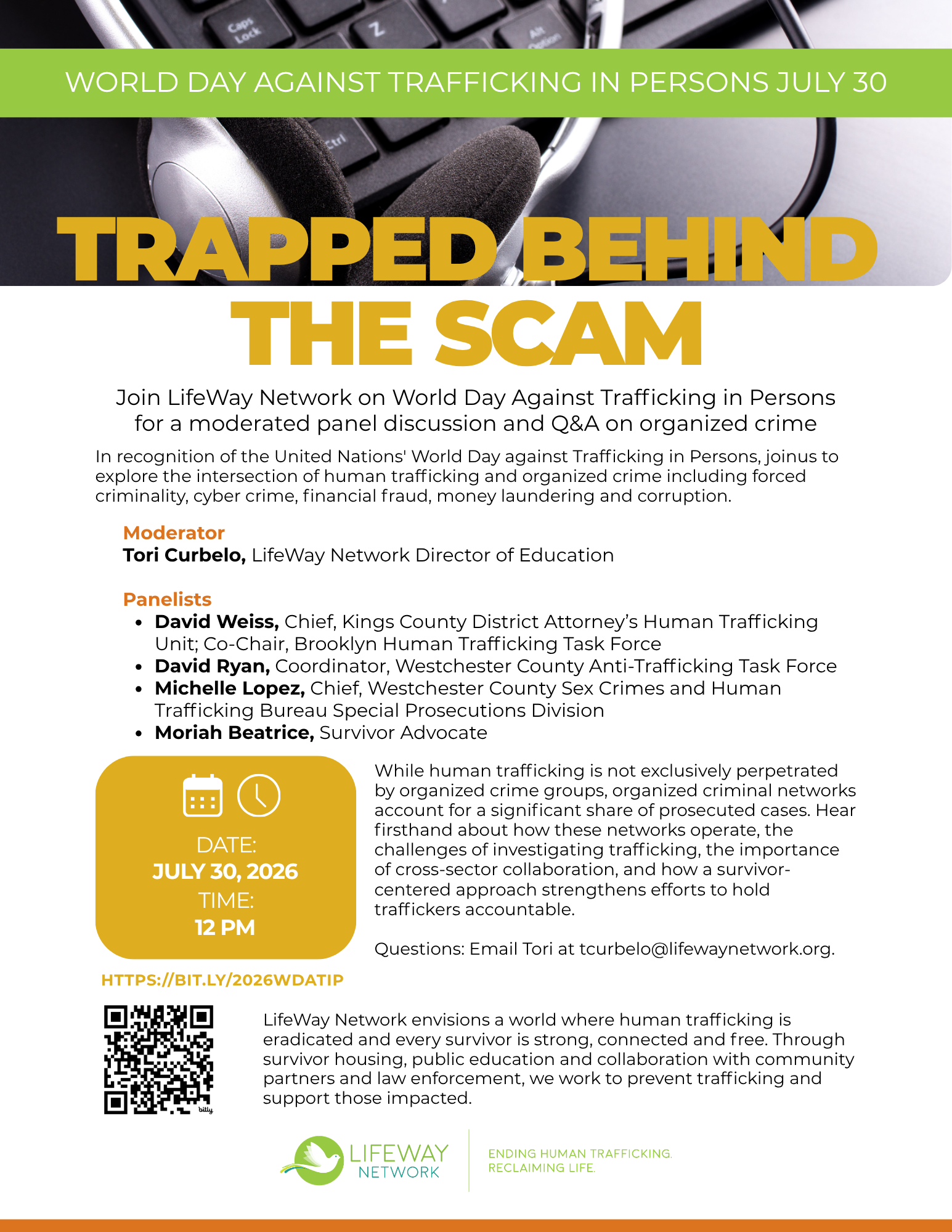
In recognition of the United Nations' World Day against Trafficking in Persons, join LifeWay Network for a moderated Q&A with law enforcement professionals and a trafficking survivor exploring the intersection of human trafficking and organized crime including forced criminality, cyber crime, financial fraud, money laundering and corruption.
Moderator
Tori Curbelo, LifeWay Network Director of Education
Panelists
David Weiss, Chief, Kings County District Attorney’s Human Trafficking Unit; Co-Chair, Brooklyn Human Trafficking Task Force
David Ryan, Coordinator, Westchester County Anti-Trafficking Task Force
Michelle Lopez, Chief, Westchester County Sex Crimes and Human Trafficking Bureau Special Prosecutions Division
Moriah Beatrice, Survivor Advocate
While human trafficking is not exclusively perpetrated by organized crime groups, organized criminal networks account for a significant share of prosecuted cases. According to the United Nations Office on Drugs and Crime, 74% of convicted traffickers were involved in organized criminal groups. Hear firsthand about how these networks operate, the challenges of investigating trafficking, the importance of cross-sector collaboration, and how a survivor-centered approach strengthens efforts to hold traffickers accountable.
Any questions? Reach out to Tori at tcurbelo@lifewaynetwork.org.
Trapped Behind the Scam Blog on Online Fraud
When you receive a scam email, suspicious text message or fraudulent job offer, your first thought is probably how to protect yourself.
What many people don’t realize is that there may be another victim on the other side of that screen.
While human trafficking has long involved force, fraud and coercion, today’s traffickers increasingly operate online. They target people searching for employment, financial stability or connection, using digital platforms to deceive them before exploiting them for profit.
Trafficking Awareness Messages to Share
Your voice is critical to raising awareness about trafficking. Join the movement and share our social media posts this month for World Day Against Trafficking in Persons. You can find us @lifewaynetwork on Instagram, Facebook and LinkedIn.
-
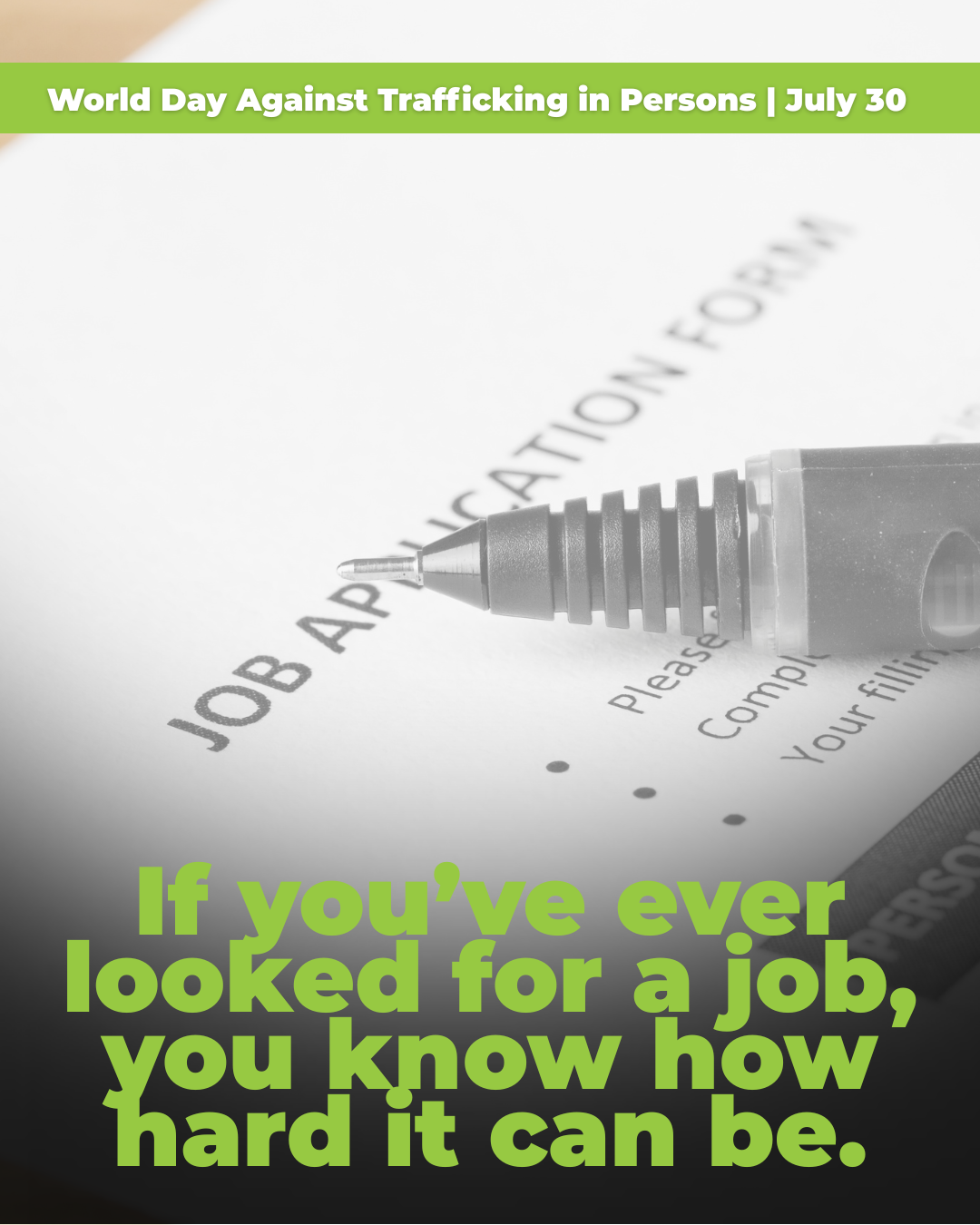
Now imagine that you’re desperately poor, hungry, uneducated and responsible for feeding yourself and your family.
What would you do for a job? What if you saw an ad online promising a good job in another country, one that could lift you out of a life of subsistence?
World Day Against Trafficking in Persons is July 30, and this year’s theme is Trapped Behind the Scam.
Transnational organized crime groups are trafficking and exploiting thousands of people and forcing them to take part in industrial-scale financial fraud operations. This growing form of trafficking is closely intertwined with cybercrime, financial fraud, money-laundering and corruption.
We usually think of the result of forced criminality — scammers stealing our information or resources. But often, there are people exploited on the other side of that misleading and persuasive phone call too.
Half the residents in our safe houses last year were survivors of labor trafficking. Their stories vary, but the force, fraud and coercion cause the same sort of trauma.
Help spread the word. Help us fight back. Donate today at LifeWayNetwork.org.
-
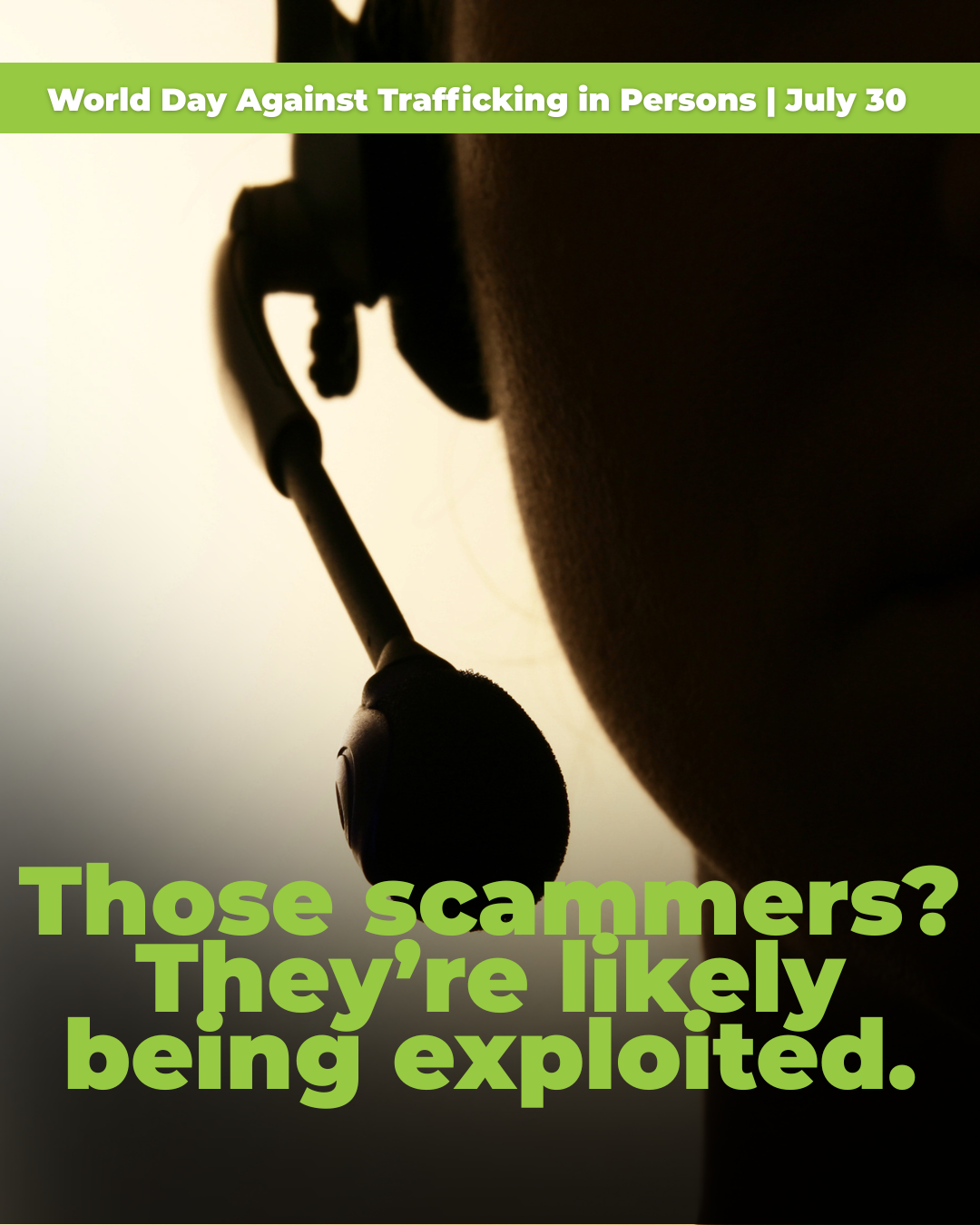
When you get a scam call or email, you think about the consequences for you, of course. But you probably didn’t realize that the person trying to scam you might have been trafficked.
These victims were looking for legitimate work. Enticed by what turned out to be sham job offers, they’re then transported to illegal compounds and coerced into running online fraud operations.
Imagine their shock.
World Day Against Trafficking in Persons is July 30, and this year’s theme is Trapped Behind the Scam.
Transnational organized crime groups are trafficking and exploiting thousands of people and forcing them to take part in industrial-scale financial fraud operations. This growing form of trafficking is closely intertwined with cybercrime, financial fraud, money-laundering and corruption.
We usually think of the result of forced criminality — scammers stealing our infomation or resources. But often, there are people exploited on the other side of that misleading and persuasive phone call too.
Half the residents in our safe houses last year were survivors of labor trafficking. Their stories vary, but the force, fraud and coercion cause the same sort of trauma.
Help spread the word. Help us support survivors. Donate today at LifeWayNetwork.org.
-
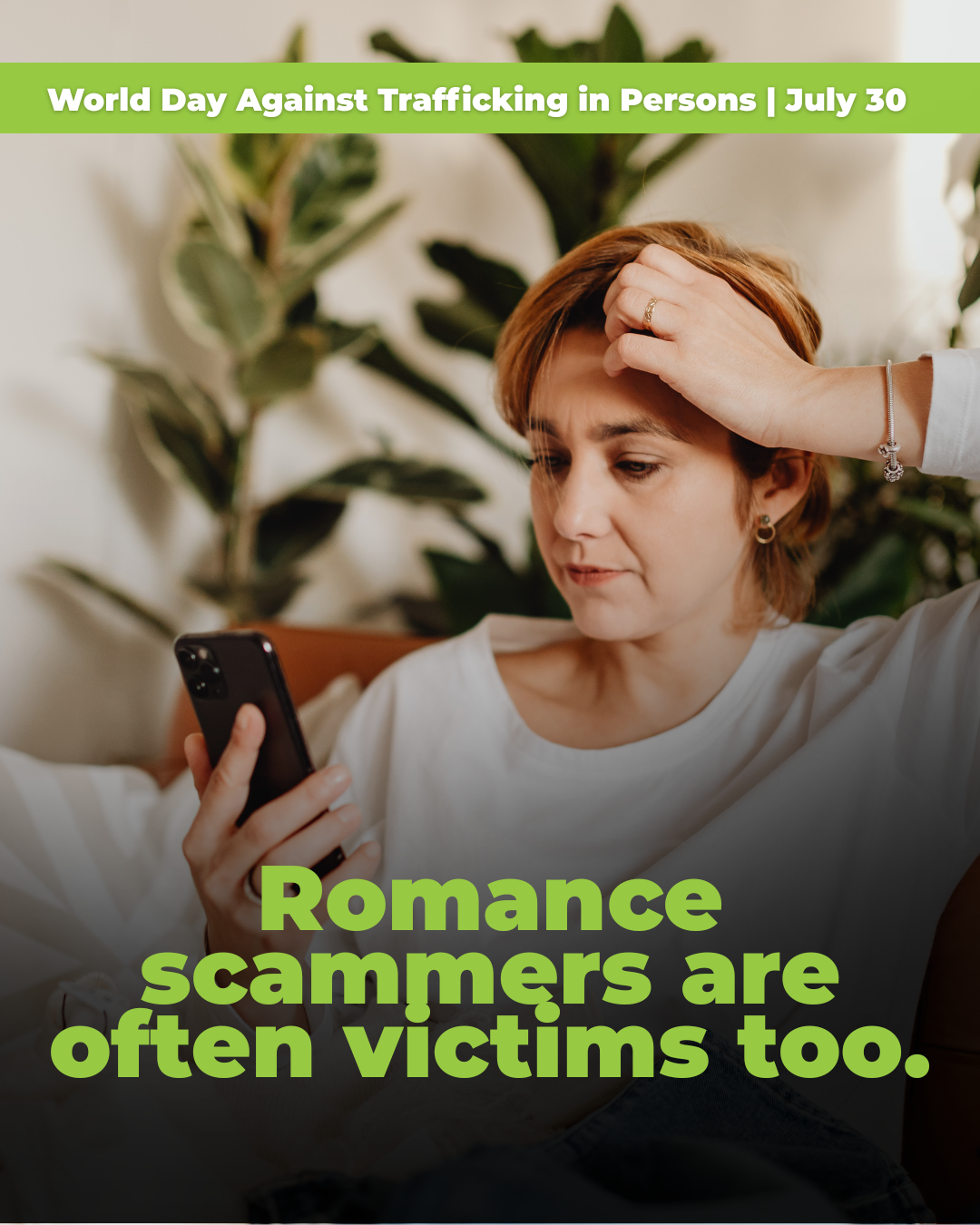
Sometimes their papers have been confiscated.
Or the amount they have to earn to buy back their freedom keeps growing.
They’re often denied food or water, kept in locked rooms, not allowed to sleep, fed drugs.
They’re sold or traded online.
Trafficking for forced criminality includes cyber-enabled fraud, in which workers are forced to execute romance scams, crypto fraud and other schemes targeting victims globally.
While not every suspicious message is connected to trafficking, understanding the warning signs can help protect ourselves, our loved ones and our communities.
Awareness is one of our strongest tools for prevention.
World Day Against Trafficking in Persons is July 30, and this year’s theme is Trapped Behind the Scam.
Transnational organized crime groups are trafficking and exploiting thousands of people and forcing them to take part in industrial-scale financial fraud operations. This growing form of trafficking is closely intertwined with cybercrime, financial fraud, money-laundering and corruption.
Half the residents in our safe houses last year were survivors of labor trafficking. Their stories vary, but the force, fraud and coercion cause the same sort of trauma.
Help spread the word. Help us fight back. Donate today at LifeWayNetwork.org.
-
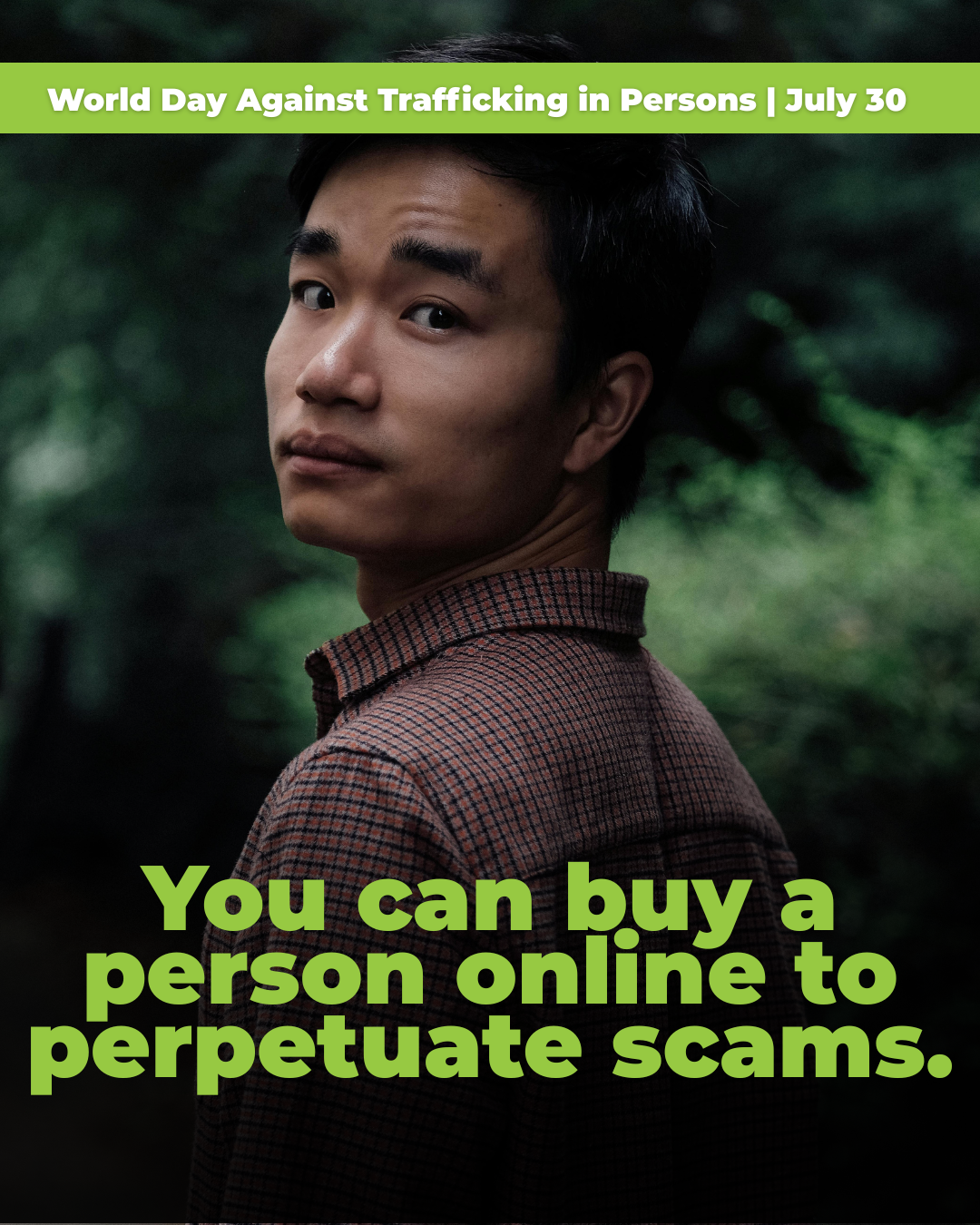
Global human trafficking often centered on s3x or on the commercial fishing industry.
But a growing number of victims are locked inside a compound, trying to take your money.
They’re desperate to avoid brutal beatings or electric shocks, to earn scraps of food or some measure of rest, to protect their families. So unless they can somehow flee, they’re forced into criminality.
A ProPublica article details how people are now bought and sold online to engage in these scams, enriching their traffickers and destroying these victims’ lives. Individuals hungry for work are enticed to accept a great offer — and then the “pig butchering” begins.
LifeWay Network serves survivors of human trafficking. We provide long-term, comprehensive safe housing to help women gain the education and skills necessary for a valid job and a life of independence. We seek to break the cycle of desperation and retrafficking that often befalls victims after they’re freed from scams, as is so heartbreakingly detailed by NPR.
World Day Against Trafficking in Persons is July 30, and this year’s theme is Trapped Behind the Scam. We’re raising funds to support our safe housing and education programs — to prevent the next scam, and to empower survivors to choose freedom. Won’t you join us?
A survivor of trafficking often finds herself with nowhere to go, no money, no identification and no certainty about what comes next. Many survivors fear being found by their trafficker. Some have been manipulated into believing they cannot survive on their own. Others have been isolated from family and friends for so long that they have no one left to call.
Freedom doesn't erase the trauma overnight.
It begins with finding a place where the door can finally be locked from the inside. A place where someone believes in them. A place where they can sleep without fear, begin to heal and imagine a future that once seemed impossible.
That's where LifeWay Network comes in.
For nearly two decades, LifeWay Network has walked alongside women as they reclaim their lives after trafficking. Through long-term safe housing and trauma-informed, survivor-centered care, women find more than shelter — they find stability, dignity and the opportunity to build lives defined by freedom rather than exploitation.
Our comprehensive services include:
Safe housing
Trauma-informed care
Individualized case management
Counseling and emotional support
Life skills training
Education and employment support
A compassionate community that walks beside each survivor
"For the first time in a long time, I feel safe. I finally believe that my future can be different." — LifeWay Resident
Your generosity makes stories like this possible. Help another woman find safety, hope and the chance to begin again.
Recovery is possible — but no one should have to walk that journey alone.
If you or someone you know may be experiencing human trafficking, help is available. In the United States, the National Human Trafficking Hotline can be reached by calling 888-373-7888 or by texting 233733 (BEFREE). Support is available 24 hours a day, 7 days a week.
How LifeWay Network Supports Survivors
How LifeWay Network Supports Trafficking Survivors
We believe in bringing people together to form a community and addressing a global issue with significant local impact. Human trafficking occurs around us. It affects people in our neighborhoods. We must join together to end trafficking today and empower survivors to reclaim a life of freedom.
Our safe housing program emphasizes an approach that provides services holistically. The support each woman receives connects her to health care, education, job skills training, legal aid and mental health services. Our education program has educated nearly 30,000 people on the realities of human trafficking. We want to stop human trafficking before it starts.
Please consider funding this work of hope. Your gift helps provide housing, meals, furnishings, personal supplies and healing resources for survivors.
Your support changes lives. Take the first step today