
Shed Light
7 Things You Can Do to Prevent Human Trafficking
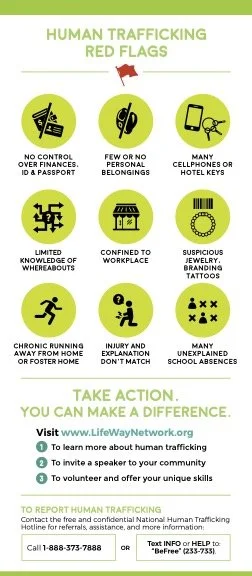
Learn the facts about human trafficking. Discover what’s true and what’s a myth, how it happens, how to spot it and what to do about it.
Seek help. If you or someone you know is at risk or experiencing trafficking, call the National Human Trafficking Hotline at 1-888-373-7888 or text HELP to 233733 (BEFREE).
Request an educational presentation. LifeWay Network offers training for schools, churches, workplaces and community groups; email education@lifewaynetwork.org.
Advocate for those at risk. Anyone can be trafficked, but certain people are more vulnerable, including children in the foster care system, people in poverty and people in marginalized groups. You can address these challenges by being a mentor or working on these causes in your community.
Shop carefully. Clothing, coffee, chocolate, produce, seafood…many products are made by people exploited for labor. Become aware and look for producers that vet their supply chains or offer Fair Trade choices.
Stay informed. Sign up for our monthly newsletter, and engage with our social media on Facebook and Instagram.
Donate to LifeWay Network’s education program. We work to educate victims on how to identify whether they’re in a trafficking situation and how to get help. We also provide preventive education to help break the cycle and stop tomorrow’s trafficking situation today.
Human trafficking myths
Myth: Human trafficking only happens in other countries.
Fact: Human trafficking exists in every country. It exists nationwide — in cities, suburbs and rural towns — and possibly in your own community.
Myth: Human trafficking victims are only foreign-born individuals.
Fact: Human trafficking victims are both US-born citizens and foreign-born individuals. Victims can be any age, race, gender or nationality.
Myth: Human trafficking means sex trafficking and exploiting someone for sexual purposes.
Fact: Forced labor is also a significant and prevalent type of human trafficking. Victims are found in legitimate and illegitimate labor industries, including sweatshops, massage parlors, agriculture, restaurants, hotels and domestic service. Sex trafficking and forced labor are both forms of human trafficking, involving exploitation of a person.
Myth: Individuals must be forced or coerced into commercial sex acts to be a victim of human trafficking.
Fact: According to the U.S. federal law on human trafficking, anyone under the age of 18 who is induced to perform commercial sex acts is a victim of human trafficking, regardless of whether he or she is forced or coerced.
Myth: Human trafficking must involve transportation, movement or travel.
Fact: Human trafficking does not require transportation or movement across neighborhoods, cities, states or national borders. An individual can be trafficked even while living at home.
Myth: Human trafficking and human smuggling are the same.
Fact: Trafficking is exploitation-based and does not require movement across borders. Human trafficking is a crime committed against an individual. Smuggling is movement-based and involves moving a person across a country’s border with that person’s consent, in violation of immigration laws. Smuggling is a crime committed against a country and its borders.
Myth: If an individual agrees to the “deal,” it’s not trafficking.
Fact: Even though an individual may have consented to do something at one point, if they’re currently in an exploitative situation where they want to leave but are held against their will, it is considered trafficking.
Myth: All human trafficking victims attempt to seek help when in public.
Fact: Victims rarely self-identify or know their rights and the services available to them. Victims may be afraid to come forward and get help; they may be forced or coerced through threats or violence; they may fear retribution from traffickers, including danger to their families; and they may not be in possession or have control of their identification documents.
Myth: Human trafficking only occurs in illegal underground industries.
Fact: Human trafficking is a hidden crime happening right under our noses in our own neighborhoods. It can occur in legal and legitimate industries.
In 2025, we launched an expanded safe housing model — increasing the length of stay for survivors from one year to three years. Our Comprehensive Transitional Safe Housing continues to offer a trauma-informed environment with wraparound support for up to one year. From there, women can now move into our newly created Semi-Independent Transitional Safe Housing, which offers a minimally structured setting for up to two additional years as they strengthen their independence and prepare for life beyond our program.
And when no housing is immediately available, our new emergency hotel stays will provide women newly breaking free from trafficking with immediate safety and care.
Human trafficking is one of the fastest-growing criminal enterprises in the world. Behind those statistics are women who deserve safety, dignity and a chance to heal. Yet many remain trapped because of economic need — when there are no resources or safety nets, exploitation takes root.
That’s why, at LifeWay Network, when women arrive directly from trafficking, we provide everything: safe homes; nutritious meals; essentials; compassionate, trauma-informed care; and the dedicated staff who walk beside each woman as she rebuilds her life.
Right now, your support is urgently needed to keep our continuum of care strong. Your generosity keeps our programs staffed and our doors open to survivors seeking safety.
As you plan your year-end giving, please remember the women in our safe homes who are courageously rebuilding their lives after trafficking. When you give, you’re not just funding a program — you’re restoring safety, dignity and hope.
Widespread federal funding cuts have left dangerous gaps in prevention and safe housing services for survivors. LifeWay Network is working to close them — but we urgently need your help.
Please make your generous gift today to help survivors of human trafficking find safety and freedom through LifeWay Network.